Introduction
Neutropenia is characterized by an absolute neutrophil count (ANC) below 1500/μL and may be transient or chronic, resulting from infectious, autoimmune, drug-related, or neoplastic causes. Although often asymptomatic, its persistence may indicate an underlying hematologic disorder and even malignancies.1–4
Among rare etiologies, large granular lymphocyte leukemia (LGLL) stands out as a lymphoproliferative neoplasm characterized by clonal expansion of cytotoxic CD8+ T lymphocytes or natural killer (NK) cells.5,6 LGLL leukemia typically affects patients over 50-65 years old, with European and Asian descent, and follows an indolent course, usually presenting with persistent cytopenias, immunologic manifestations and splenomegaly, which may lead to treatment with steroids even before a definitive diagnosis.6
Diagnosis relies on immunophenotyping and clonality studies and is often delayed due to nonspecific clinical presentation and overlap with benign conditions.2,4,5,7 Treatment is similar to other conditions with immune predominance, even though it is a clonal disorder. Metotrexate, ciclosporine and ciclofosfamide are the main choices with little variation between them, even watch-and-wait strategy is feasible for the less severe cases.4,5
Case Report
A 40-year-old white woman sought medical attention after leukopenia was detected during routine laboratory testing following a nonspecific viral infection. However, leukopenia had already been documented for approximately 3 to 4 years prior to the definitive diagnosis. During this period, the patient underwent routine gynecological and general clinical follow-up, repeatedly presenting ANCs below 500/mm3. These findings were attributed to transient infectious processes, with an expectation of spontaneous normalization, and no structured etiological investigation was conducted.
She reported episodes of dermatitis in the perinasal region, axillary area, and cubital folds, without systemic symptoms such as persistent fever, weight loss, or recurrent severe infections. Laboratory tests revealed a leukocyte count of 2700/mm3 and ANC of 300/mm3, with hemoglobin and platelet levels within normal ranges. Rheumatoid factor was mildly positive. Serologic and immunologic tests did not reveal relevant infectious or autoimmune causes. Whole-body imaging and gynecological screening showed no abnormalities.
Further investigation included testing for paroxysmal nocturnal hemoglobinuria and a bone marrow biopsy. The bone marrow aspirate demonstrated hypocellularity without blasts or dysplasia. Immunophenotyping revealed 11.3% clonal CD8+ T lymphocytes positive for CD3, CD8, CD45, and CD57, consistent with indolent T-cell LGLL. Molecular studies did not identify pathogenic mutations. Table 1 shows how the patient evolved before and after treatment in terms of laboratory results.
Discussion
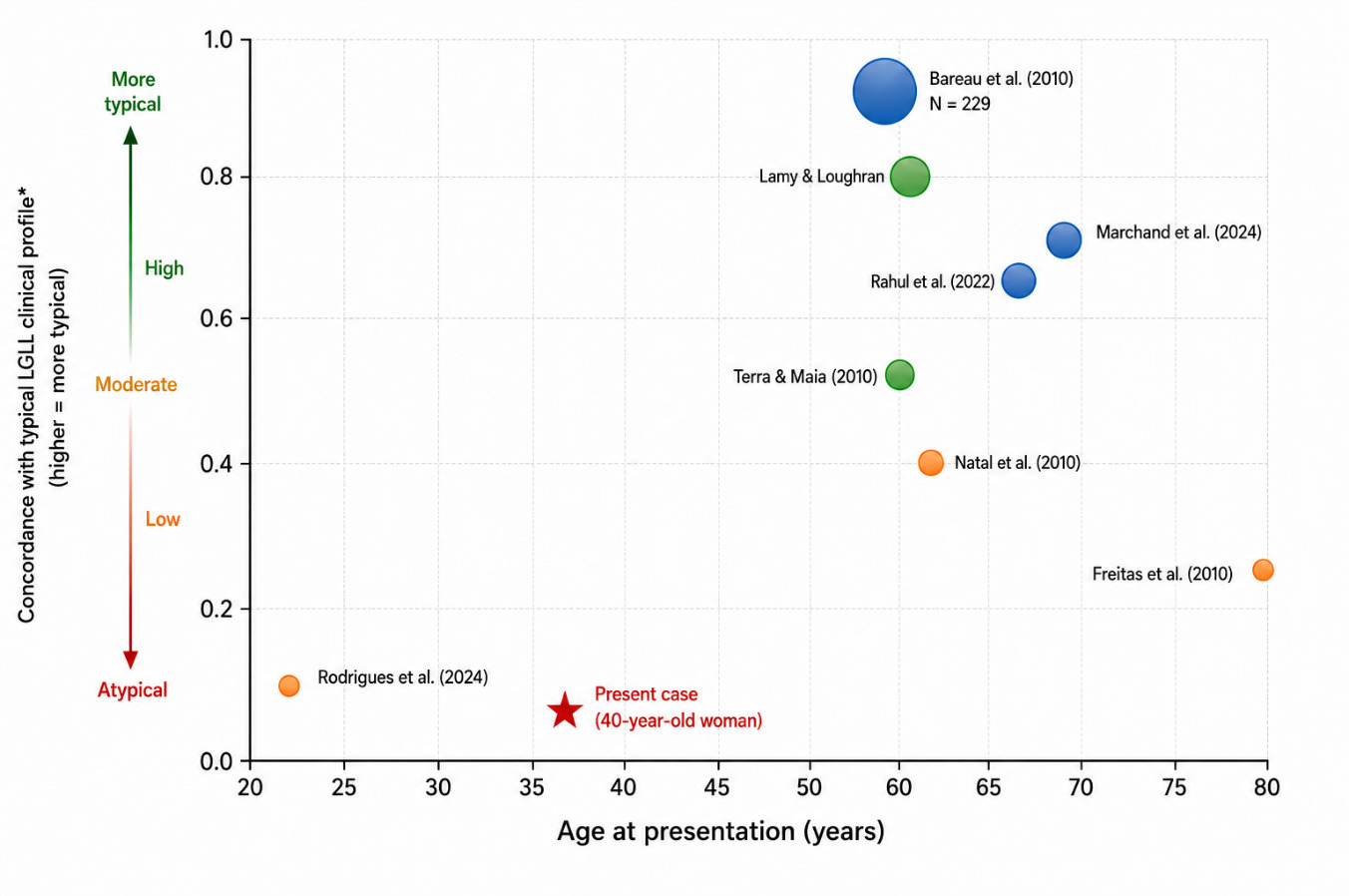
LGLL is a rare hematologic neoplasm, with an estimated incidence ranging from 0.2 to 0.72 cases per million individuals per year.5,6,8 The largest published cohort, comprising 229 patients, demonstrated that neutropenia is among the most frequent clinical manifestation and confirmed the typically indolent course of T-cell LGLL, although a substantial proportion of patients eventually require immunosuppressive therapy.9 The present case is atypical due to the patient’s age and ethnicity, since the indolent form, which is the type 1 or T-cell predominant, is more frequent in elderly patients, up to 70 years old and Caucasian. Besides that, the absence of splenomegaly and anemia, that could be present in up to 50% of patients also constitutes an unusual characteristic.5,6,8 The presentation of type 2, the NK-cell mediated disease, is more aggressive and seen in Asian women between 40-50 years of age.5 Figure 1 helps to demonstrate the atypical profile:
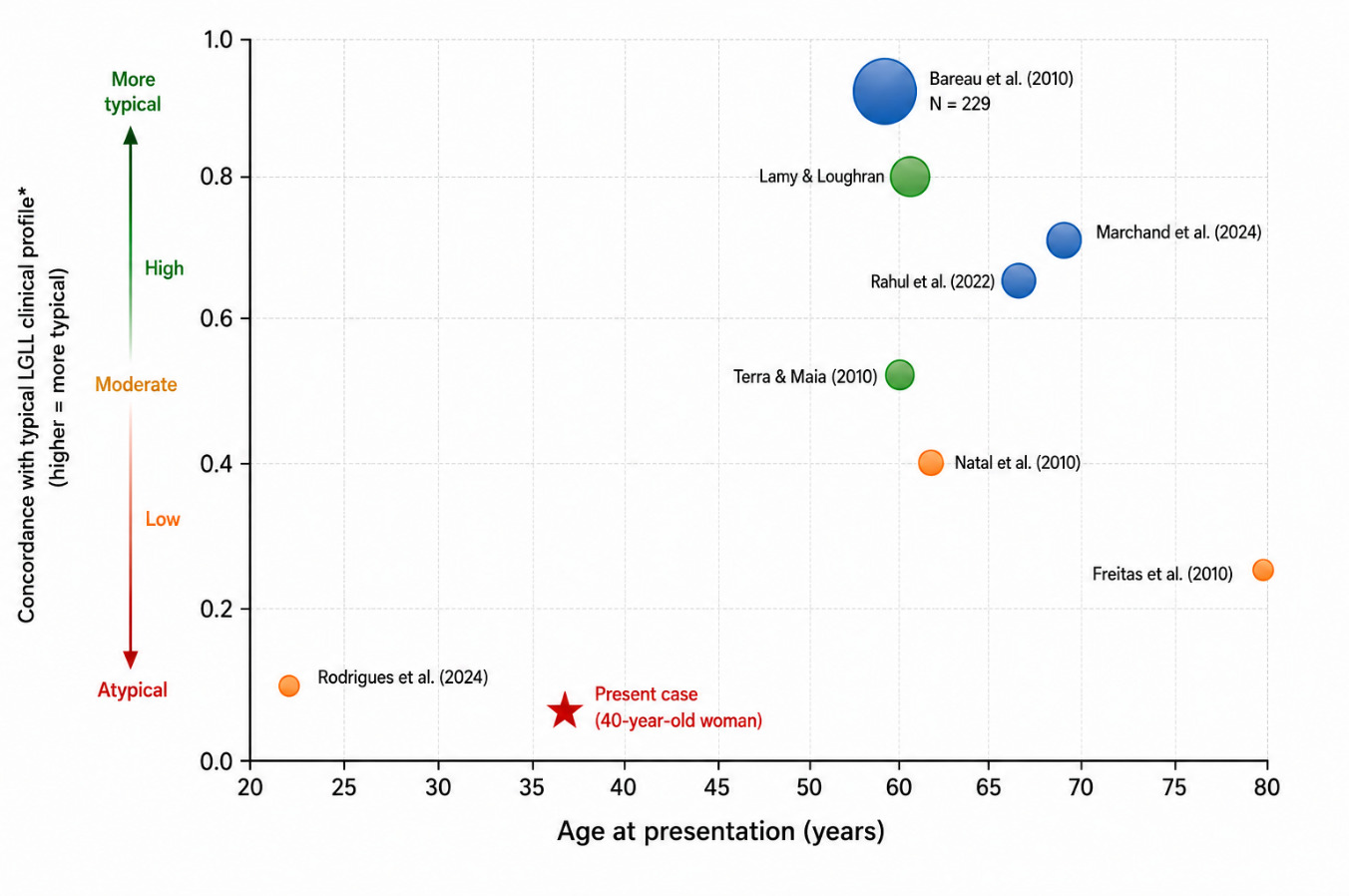
Figure 1 illustrates the clinical profile reports of published T-cell large granular lymphocyte leukemia (T-LGLL) compared with the present case. The x-axis represents age at presentation, while the y-axis reflects concordance with the typical LGLL clinical phenotype. Bubble size is proportional to the number of patients reported in each study. The present case is highlighted by a red star.
A particularly relevant aspect of this case is the prolonged period of severe neutropenia without adequate etiological investigation. For several years, the patient had shown persistently low absolute neutrophil counts below 500/mm3, under routine clinical follow-up with other specialists and her primary care physician. The absence of systemic symptoms likely contributed to minimization of the laboratory findings and subsequent diagnostic delay. However, persistent severe neutropenia, even when asymptomatic, should not be considered benign without structured evaluation.1,3
The differential diagnosis of chronic neutropenia includes infectious, autoimmune, drug-related causes, and other hematologic neoplasms. Systematic exclusion of these conditions is essential before establishing a clonal etiology such as LGLL. Immunophenotyping remains the cornerstone of diagnosis by demonstrating expansion of clonal cytotoxic T or NK cells, while molecular studies, including STAT3 mutation analysis and T-cell receptor clonality, may provide additional diagnostic support in selected patients.2–4,7
This case highlights a missed diagnostic window and reinforces that isolated neutropenia is not synonymous with a self-limited condition. Although rare, LGLL should be included in the differential diagnosis of chronic neutropenia after exclusion of more prevalent causes. Early recognition allows appropriate intervention and reduces the risk of prolonged underdiagnosis.1,3
Methotrexate remains the preferred first-line therapy for symptomatic indolent T-LGLL, particularly in patients with neutropenia, whereas cyclophosphamide or cyclosporine are recommended for refractory cases or according to the predominant clinical manifestations.5,6,10 Treatment response should generally be assessed only after several months of therapy, as delayed hematologic improvement is common, and premature treatment discontinuation should be avoided.10
Recent advances have improved understanding of the pathogenesis of LGLL, emphasizing chronic antigenic stimulation and dysregulated JAK/STAT signaling as key mechanisms underlying persistent clonal lymphocyte expansion, which may support the development of future targeted therapies.11
Conclusion
Chronic isolated neutropenia should always prompt thorough investigation, as it may conceal serious conditions such as LGLL. Persistent severe neutropenia, even in the absence of symptoms, should not be underestimated. This report emphasizes the importance of diagnostic vigilance in cases of prolonged hematologic abnormalities and reinforces the role of immunophenotyping in early diagnosis.
Ethics Approval and Consent
The study was approved by the Ethics Committee of the State University of Western Paraná (approval number 8.018.166, CAAE number 92617925.9.0000.0107). The patient provided written informed consent.
Conflict of Interest
The authors declare no conflicts of interest.
Funding
No funding was received for this study.
Acknowledgments
The authors thank the patient for her cooperation and the State University of Western Paraná for academic support.
Authors’ Contribution - CRediT
Conceptualization: Luiz F. Becker (Equal), Vicente de A.M. Leal (Equal), Luiz E. Bernardi (Equal). Data curation: Luiz F. Becker (Equal), Vinicius M. Gula (Equal), Louise A.M. Rodrigues (Equal). Investigation: Luiz F. Becker (Equal), Vinicius M. Gula (Equal), Louise A.M. Rodrigues (Equal). Methodology: Luiz F. Becker (Equal), Vicente de A.M. Leal (Equal), Luiz E. Bernardi (Equal). Supervision: Luiz F. Becker (Equal), Vicente de A.M. Leal (Equal), Luiz E. Bernardi (Equal). Writing – original draft: Luiz F. Becker (Equal), Vinicius M. Gula (Equal), Louise A.M. Rodrigues (Equal). Writing – review & editing: Luiz F. Becker (Equal), Vicente de A.M. Leal (Equal), Luiz E. Bernardi (Equal).